January 21, 2026
Sarco Pod for Couples
In September 2024, a 64-year-old woman became the first human to experience her last moments in a futuristic killing device known as the Sarco pod.
Amid a verdant forest in Switzerland’s Schaffhausen region, she climbed inside the 3D-printed capsule, pressed a button, and took a deep breath before nitrogen flooded the vessel.
The woman lost consciousness and died within a few minutes. But the controversial Sarco pod’s first death would be its last – at least for now.
Swiss police arrived, seized the pod, and arrested the only person present during the death, the late Dr Florian Willet, co-president of the assisted suicide organisation the Last Resort.
They also arrested his lawyers and a photographer who documented the woman’s arrival.
After police ruled out intentional homicide, all were released, but Philip Nitschke – the Sarco’s Australian-born inventor and a pro-euthanasia activist – was startled.

He was surprised by what he perceived as the police’s overzealousness – as well bogus claims in the media about signs of strangulation on the woman’s body – and was advised by his lawyers to remain in the Netherlands until further notice.
But after being forced to halt his development of euthanasia devices, Nitschke is tentatively devising the rollout of his next range of gadgets, providing the public with innovative, and divisive, ways to die.
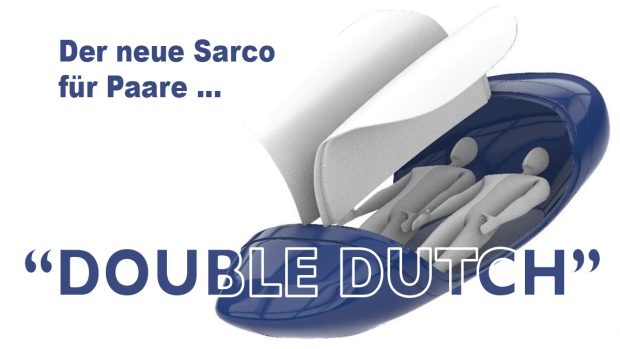
One is the Double Dutch Sarco pod, a new-and-improved euthanasia capsule, now augmented with AI and purpose-built for couples who want to draw their last breaths side by side.
Talking to the Daily Mail, Nitschke says: ‘I’m not suggesting everyone’s going to race forward and say: “Boy, I really want to climb into one of those things.”
‘But some people do.’ The woman who tested the Sarco told the assisted dying campaigner before she died that she had read about the device, and liked the idea.
Design of the ‘Double Dutch’ Sarco pod, which has been printed by the 3D printer and is being assembled
pod’ known as the Sarco in Rotterdam, The Netherlands, in 2024
Nitschke is the director of the pro-Euthanasia charity Exit International, which provides ‘information and guidance’ on assisted suicide through online forums to its more than 30,000 members.
In terms of the Double Dutch capsule, ‘most of the bits have been printed’, and it’s just a matter of time before Nitschke’s designer in Rotterdam assembles all the parts together.
‘He’s been working away on it,’ Nitschke says. ‘We expect that in a couple of months it’ll be ready.’
This version of the Sarco has space to fit two people in the same compartment, and is built with two buttons which must be pressed simultaneously.
If only one half of the couple presses a button, the machine won’t work.
‘If they both want to die, they have to die together, [and] they have to both press the buttons at the same time.’
Nitschke has faced a choir of detractors who oppose his methods, with Alistair Thompson, a spokesperson for anti-euthanasia group Care Not Killing, dubbing the Sarco a ‘personalised gas chamber’.
Other people, interested in seeking assisted dying, reached out and told him they liked the idea in theory, but were disturbed by the fact that they’d be alone in the pod.
‘One of the comments made was: “It’s so lonely, I want to be held by someone when I die… when you’re in a capsule, you’re isolated.”’
He took the feedback on board and thought: ‘What about when people want to die together?’
The result was the Double Dutch – twice the size of the original Sarco, and twice the capacity.
Not only is the pod made for a couple, it’s also been designed to maximise efficiency, taking advantage of recent technological advancements.
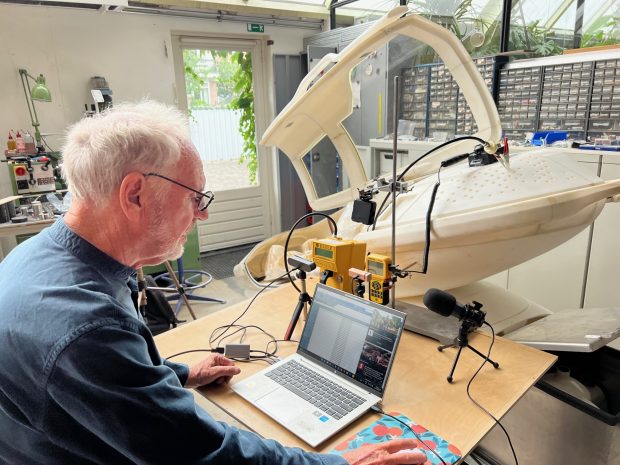
‘One of the parts to the device which hadn’t been finished, but is now finished, is the artificial intelligence,’ he says.
As is the case in all countries where assisted dying is legal, the act is only permissible in Switzerland if the person in question has the mental capacity to make the decision to end their life.
That’s where AI enters the Sarco pod.
Future users won’t need to go through a psychiatric assessment to determine mental capacity – instead, they’ll undergo an AI ‘test’.
If they pass the test, that activates ‘the power to switch on the Sarco’.
‘That part wasn’t working when we first used the device,’ he says, meaning the first woman to use the Sarco pod went through a conventional evaluation.
‘Traditionally, that’s done by talking to a psychiatrist for five minutes, and we did that. She had a rather traditional assessment of mental capacity through a Dutch psychiatrist.
‘But with the new Double Dutch, we’ll have the software incorporated, so you’ll have to do your little test online with an avatar, and if you pass that test, then the avatar tells you you’ve got mental capacity.’
Once the Sarco is ignited with power, on completion of the test, it’ll stay on for the next 24 hours – a window during which one can ‘climb in and press the button, if you want to’.
Once that time window elapses, users will have to take the test again.
In countries where assisted dying is legal, certain medical preconditions are required, whereas a person seeking assistance in Switzerland need not be terminally ill.
That makes the country the only place where the Double Dutch Sarco can debut.
‘I’ve noticed over the last decade, where couples have been together for a long time, [they] often do say they wish to die together,’ Nitschke says.
‘One may be very sick, and often is, and that’s why they want help to die, but their partner says: “Look, I’ve been with this person for 50 years, and I want to die at the same time.”
‘Under the laws of just about everywhere except Switzerland, that’s not possible. I mean, you’ve got to be sick. You’ve got to be so sick that you’d qualify under the restrictions – that is, terminally ill.’
The likelihood of two people satisfying that criteria concurrently is rare, which means couples often travel to Switzerland to end their lives together – taking advantage of its non-medical framework.
While Switzerland may be the only nation the Double Dutch will see the light of day, Nitschke is still in legal purgatory.
Investigators dropped the homicide investigation against Dr Willet, releasing him from pre-trial detention after 70 days, but the Swiss police aren’t finished with the Sarco pod, and still haven’t given it back to its inventor.
The authorities are still determining whether what happened in the forest in September 2024 was an illegal assisted suicide, motivated by ‘selfish reasons’ such as reputational enhancement.
Nitschke thinks the legal basis of this argument is unconvincing, even funny. ‘I’ve been an activist in this issue for 30 years,’ he says.
‘The idea that I was public about the fact that the Sarco was being used, and […] that was done for reputational enhancement, rather than political activism, is a bit bizarre. I mean, you could hardly get far trying to effect social change without talking to the media.’
‘They also used the fact that it could have been a murder to justify an international warrant that allowed them to take a whole heap of equipment out of my Amsterdam office,’ he says – equipment that they haven’t given back.
Even if the Double Dutch comes to fruition, he’ll have to wait until Switzerland completes their investigation as to whether the Sarco is legal.
‘There’s no rushing, because having got it ready, the question is, what the hell do we do with it?
We had thought that there should have been some resolution by now about whether or not the use of such a device would be lawful in Switzerland, and of course that hasn’t happened.

Sarco
‘And until it has happened, we’re effectively in a situation where we’ve lost the device they seized, we may have a new one, but can’t use it.’
Nitschke largely blames the police for the death of Dr Willet, co-president of The Last Resort, a Swiss affiliate of his assisted dying group Exit International.
When Nitschke saw him in Amsterdam after his 70 days in pre-trial detention, ‘he was quite a mess’.
‘He didn’t expect, of course, to spend any time in any prison. He realised he hadn’t broken the law, and he certainly hadn’t murdered anyone, so he’d been pretty upset by the whole process.’
Exit International said the first woman to die using the Sarco pod suffered from ‘severe immune compromise’, and claimed there was ‘no foundation’ to the now-dropped allegations by a prosecutor that she suffered strangulation in the capsule.
Following his release, Dr Willet, 47, sought psychiatric support in Zurich at Christmas, but discharged himself from the clinic before New Year’s Eve.
Then in January 2025, he fell from the third floor of his Zurich flat.
‘He was paranoid, he was upset, he thought he was being monitored and watched… things, I think, that could be explained by a person who suddenly finds themselves in some sort of nightmare.’
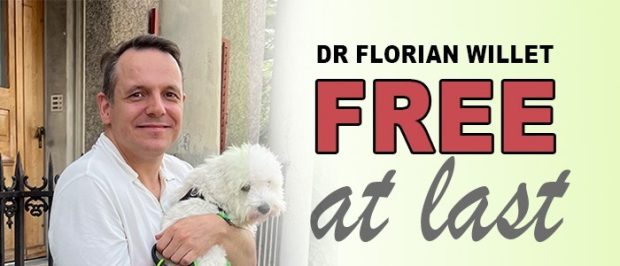
Nitschke said Dr Willet was diagnosed with acute polymorphic disorder brought on by the stress and trauma of detainment and false allegations. Following his fall, he had surgery and went to rehab.
But five months later, on May 5, he died by assisted suicide in Germany.
‘In the final months of his life, Dr Florian Willet shouldered more than any man should,’ Nitschke wrote in a statement at the time following his death.
When asked what it feels like dying inside the Sarco pod, Nitschke insists it’s ‘peaceful’ and ‘fast’.
His account differs wildly from liberal lawmakers in the United States, who have been campaigning against nitrogen hypoxia as a method of execution on the grounds of its excessive cruelty.
Since Alabama first used it as an execution method in January 2024, nitrogen hypoxia has been used eight times, most recently to kill Anthony Boyd, 54, for the 1993 killing of a man who had owed him and others money.
Witnesses described seeing Boyd convulse and heave for about 15 minutes before being pronounced dead about 15 minutes later.
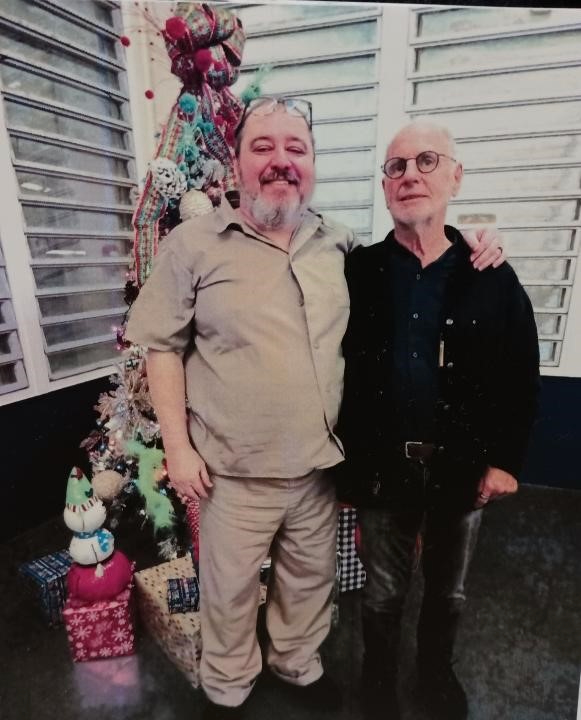
With Kenny Smith in Alabama, shortly before he was executed using nitrogen gas. Philip appeared as an expert witness against the State of Alabama.
Justice Sonia Sotomayor had issued a dissent against the scheduled execution, calling nitrogen hypoxia a ‘cruel form of execution’ that should be banned.
Nitschke, an opponent of capital punishment, agrees that nitrogen is a painful form of execution, but that’s because those on death row don’t want to die, and try to resist the process by holding their breath.
‘What’s happened is every time a person has been executed using nitrogen gas, reports turn up in the media from the witnesses…And they’re always about grim, horrible deaths, with people struggling against the restraints, and gasping and suffocating.
‘But it’s different when a person’s being executed, because a person being executed doesn’t want to die, and the people I have dealings with who wish to die cooperate, and do what you need to do to make this a peaceful, fast process.’
‘In other words, what you’ve got to do is breathe out before the nitrogen is switched on,’ he says, ‘and then take a really deep big breath.’
The result, he promises, is swift and painless, and a far-cry from being chained up and having a mask forced on you.
Nitschke would know. He was invited to Alabama’s Holman Correctional Facility in early 2024, before the scheduled execution of Kenneth Eugene Smith, who became the first man to be executed by nitrogen hypoxia.
He was asked by Smith’s lawyers to look at the ‘new system,’ hoping that as an expert in nitrogen hypoxia, he could help make a case against the execution.
‘And it was pretty grim,’ he says. ‘Everything about it is awful.’ He was strapped to the gurney and had the full-face mask attached. ‘It’s a bit like having an octopus strapped to your face.’
The Sarco, on the other hand, is designed with peace and comfort in mind, and a desire to make death feel ‘aesthetically pleasant’.
‘I said to the first designer: “Can we do something to make it look good?” Hence the idea of the spaceship, the idea that you’re going somewhere.’

An inflatable model of Sarco on the Australian Gold Coast, 2023
Born in the 1940s in Ardrossan, South Australia, Nitschke is the son of school teachers.
He studied physics at the University of Adelaide before gaining a PhD from Flinders University in laser physics in 1972.
He was training to be a doctor in a Darwin hospital when he heard a radio show that would change his life: it was the chief minister of the Northern Territory of Australia, campaigning for euthanasia for the terminally ill.
He couldn’t help but be persuaded by the argument, and began campaigning for the contentious cause.
Despite several doctors in Australia voicing their fierce objections, the Rights of the Terminally Ill Act – the world’s first assisted dying legislation – passed by five votes and became law in 1996.
The legislation was short-lived, however, and overturned by the Australian Parliament in March 1997, after uproar from the medical profession and the church.
But within the short window when it was active, four Australians in the Northern Territory died legally by lethal injection, and Nitschke assisted each time.
In 2014, the Medical Board of Australia suspended Nitschke’s practitioner’s licence after he supported 45-year-old Nigel Brayley’s decision to take his own life.
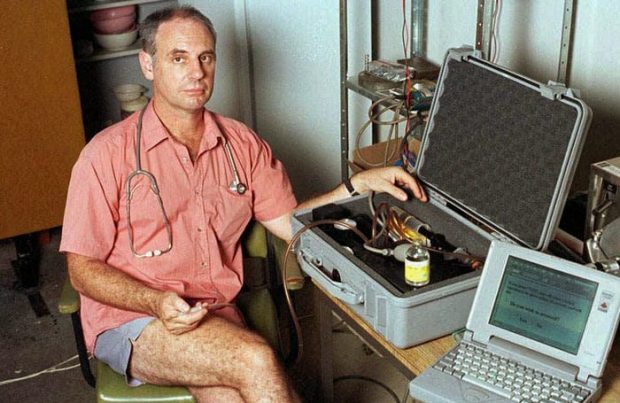
Philip Nitschke in Darwin Australia with the Deliverance Machine, 1996
The doctor appealed the decision twice and eventually the Darwin Supreme Court ruled in his favour – overturning the judgement that he posed a serious and immediate risk to people.
But the reinstatement of his medical licence came with a cost: he was only allowed to practise again under 25 conditions, including no longer bringing up the topic of suicide to patients.
An enraged Nitschke called the conditions a ‘heavy handed and clumsy attempt to restrict the free flow of information on end-of-life choice’ and publicly burned his medical certificate in response, announcing he would leave the profession.
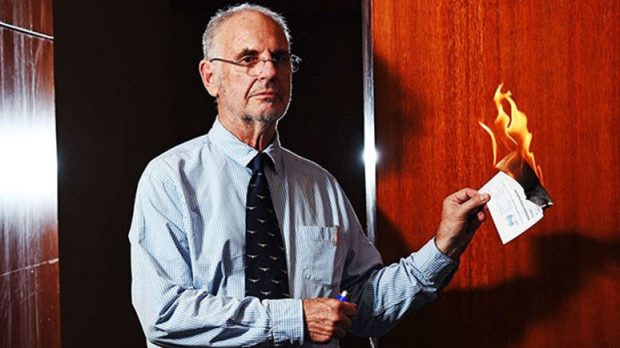
Philip burning his medical license, Australia 2013
As well as the Double Dutch Sarco pod, Nitschke is developing a build-it-yourself device known as the Kairos Kollar.
Kairos comes from the Greek, meaning a ‘time when conditions are right for the accomplishment of a crucial action’, he says.
He has been exhibiting the latest gadget at his Exit Workshops, where guests gather to learn about legal issues surrounding euthanasia, the physiology of death, and ways to kill themselves.
The workshops are a great hit, he says, and he’s travelled all around Europe and North America to deliver them, speaking to an audience mostly in their mid seventies and generally more female than male.
Soon, he will be announcing the first trials of the collar in Switzerland.
It works by putting pressure against the carotid arteries and baroreceptors in the neck, cutting off blood flow to the brain and causing the wearer to lose consciousness before dying.
In a post on X, Nitschke could hardly conceal his excitement for the developing technology: ‘The Exit Kairos Kollar, an important development in the assisted dying quest…fast, reliable, drug free, and, importantly, unrestrictable!’

The collar is linked to a ‘small air bag’ inflator that is switched on via an ‘activation button’, accessible via a mobile phone app.
Similar to the new Sarco, mental capacity will be assessed through the AI test.
He can tell the collar will be popular, he says, based on the amount of mail he’s getting inquiring about the device.
What people find so appealing is that ‘it’s got infinite shelf life’.
‘You don’t have to worry about drugs getting too old to be useful, you can put it in the cupboard once you’ve got one, and it will last forever.
‘And it can’t be stopped. So, it’s got a lot going for it.’
Unlike the Sarco, which people can’t build at home, the idea with the Kairos Kollar is that people will assemble it themselves. This is crucial, because selling such a product would be illegal.
He’s developed it in answer to people’s worries that they won’t meet their country’s medical criteria for assisted dying.
‘We’re watching that debate play out now, of course, in the UK, with multiple conditions that will need to be met if you’re to satisfy any sort of legislative process which would allow you lawful help from a doctor to end your life.’
With the collar safe at home, people will have access to a way of dying that escapes those barriers.
He based his research on controversial experiments conducted in the United States in the 1940s during the Second World War, when scientists were trying to work out why Air Force pilots were losing consciousness during high-speed maneuvers, and most often while quickly pulling up after dive-bombing
In the experiments that became to be known as the ‘Red Wing Studies’, researchers built a neck cuff to block blood flow to the brain in human subjects, including schizophrenic patients and prison inmates.
They worked out that if you put pressure ‘in the right place in a special way,’ that person will lose consciousness in five to seven seconds and die.
‘It looked like something that needed to be pursued, so I’ve been in the process of building the first one now.’
All of the details of construction will be available in his ever-expanding ‘Peaceful Pill eHandbook’, updated six times a year with information on assisted suicide.

As well as the Kairos Kollar, Nitschke is also building a ‘kill switch’ implant which could allow dementia sufferers to seal the time of their death years in advance.
The mechanism would be sewn into a person’s body – most likely their leg – and contain a timer which would make a beeping noise and vibrate to warn them to turn it off each day.
If they failed to do so due to deteriorating brain function in the late stages of the disease, Nitschke says it would then release a lethal substance into their system to kill them.
The assisted dying campaigner believes that his new device could solve the ‘dementia dilemma’ – the situation whereby someone suffering from the disease is seen as lacking the mental capacity to consent to their death.
Nitschke knows his methods are controversial, but when asked whether his devices are cold or dehumanising, he goes back to the fact that there’s a demand for the kind of machines that grant people agency.
‘We’ve found that amongst our elderly, 70-year-old-plus members around the world, that they really want this. They want to have absolute control,’ he says.
‘That is, they know it works. They know they’ve got it in the cupboard. They don’t have to go and seek permission from the doctor and prove that they’re sick enough to be eligible.
‘They simply go to the cupboard. That makes people stop worrying, and we’ve found that elderly people live longer, paradoxically, by having access to what is a reliable, lethal process, which will guarantee them a peaceful death at the time of their choosing.’