
December 2, 2025
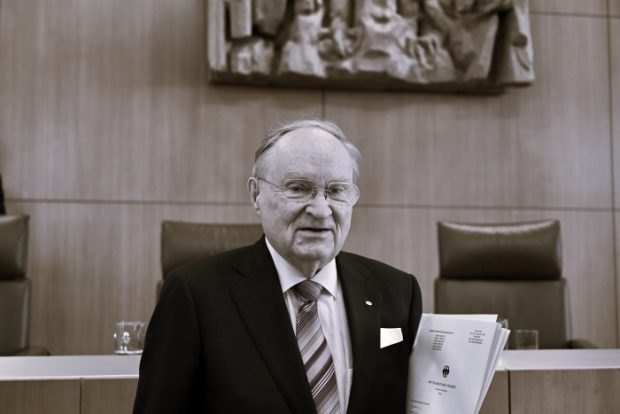
Obituary – Ludwig Minelli
The Swiss founder of DIGNITAS, GBS and IFW advisory board member Ludwig A. Minelli died last Saturday as he had lived: self-determined.
Michael Schmidt-Salomon remembers his foundation colleague, long-time comrade-in-arms and friend.
‘Meinetwegen. Episoden eines glücklichen, bewegten und bewegenden Lebens’ (For my sake. Episodes from a happy, eventful and moving life) is the title of the autobiography Ludwig A. Minelli had been working on in recent months.
It is a voluminous work of 846 pages, as unusual and headstrong as its author was.
Vico, as I was privileged to call him, sent me the manuscript on 24 November, five days before his suicide on 29 November.
In his accompanying email, he not only thanked me for our friendship, which had ‘always been particularly valuable’ to him, but also informed me that, as a result of progressive cancer, he intended to ‘take his leave of this world’ in the near future.
I wrote back to him that I would miss him very much, even if it was a small consolation that he would ‘certainly deal with this difficult situation much more calmly’ than most of us.
I first met Vico around 20 years ago. After one of my lectures in Switzerland, he invited me to a posh restaurant in Bern.
After the obligatory, albeit corny joke that I would gladly have a glass of wine with him, but not a cocktail (in view of the ‘death cocktail’ that DIGNITAS administered at the time), an amusing and exciting conversation ensued, during which it quickly became clear to me that this ‘notorious Mr Minelli’ was much more than just the founder of a Swiss euthanasia organisation.
Vico was extremely witty and well-read, able to quote entire passages from Schopenhauer and Feuerbach from memory, as well as countless verses by Heinrich Heine, Wilhelm Busch and Georg Kreisler – a skill I always admired in him and which he retained until the end of his life.
From journalist to human rights lawyer
Vico began his professional career as a journalist, first at the Zurich daily newspaper Die Tat, then at United Press International (1961–64) and Der Spiegel (1964–74).
As a Spiegel correspondent, Vico met many important contemporaries, including writers such as Friedrich Dürrenmatt and painters such as Oskar Kokoschka.
As fascinating as this was, one topic fascinated him even more, namely the European Convention on Human Rights (ECHR), which was signed in Rome on 4 November 1950 but was not ratified in Switzerland until November 1974.
In order to help the ECHR gain acceptance in his home country (but also in other European countries), Vico founded the Swiss Society for the European Convention on Human Rights (SGEMKO) in 1978.
Two years earlier (1976), at the age of 44, he had begun studying law at the University of Zurich, graduating in 1981 to work as a solicitor specialising in human rights.
Even before studying law, he had already secured two landmark rulings on the humanisation of the penal system in Switzerland, now known as ‘Minelli I’ and ‘Minelli II’, followed in 1992 by ‘Minelli III’ with the same objective.
Vico was always there when it came to defending individual rights of self-determination against ‘state arbitrariness’ or against paternalistic norms, mostly shaped by Christian-conservative convictions.
Among other things, he advocated for the ‘right to intoxication’ (such as the legalisation of cannabis) and for the release of “offensive” literature that had been classified as ‘pornographic’ by religious moral guardians, whom he was able to mock delightfully.
Living with dignity – dying with dignity
In the mid-1990s, it was not yet foreseeable that the name ‘Ludwig A. Minelli’ would one day be associated with the right to a self-determined death, but this resulted from a dramatic general meeting of the Swiss euthanasia organisation ‘EXIT’ in May 1998.
At that time, EXIT managing director Peter Holenstein, whom Vico supported as a legal advisor, wanted to reform the association so that it not only facilitated assisted suicide, but also prevented suicides out of despair, which was vehemently rejected by the association’s members.
That same night, Vico and a few like-minded people founded the association ‘DIGNITAS – Live with dignity – Die with dignity’.
Its success to date lies not only in having helped several thousand people to die with dignity, but also in having prevented significantly more people from committing suicide out of despair.
Successful suicide prevention requires accepting the right to self-determined death and, where possible, pointing out ways that could make continuing to live attractive.
The fact that DIGNITAS quickly became known beyond Switzerland is linked to a decision that was as courageous as it was momentous: unlike EXIT, DIGNITAS also offers assisted suicide to people from abroad!
Conservative critics criticised this as ‘death tourism to Switzerland’, but Vico immediately countered this by referring to it as ‘freedom tourism to Switzerland’.
After all, he argued, the core issue was that those who wanted to exercise their freedom to die with dignity and self-determination had little choice but to travel to Switzerland due to restrictive legislation in their own countries.
With this argument, Vico put pressure on many foreign governments, triggering an intense debate on ‘self-determination at the end of life’ in several countries (not least in Germany).
The right to final assistance
After our first conversation in Bern, Vico and I stayed in touch, meeting regularly after my lectures and television appearances in Switzerland. However, closer cooperation did not begin until 2014, when it became public that the Merkel government wanted to ban ‘commercial suicide assistance’ (a derogatory term for ‘professional assisted suicide’).
From the outset, Vico advised us on the planning of the campaign ‘Mein Ende gehört mir!’ (My end belongs to me!) – and he was also one of the first proofreaders of the book “Letzte Hilfe. A Plea for Self-Determined Dying,” which I wrote in 2014 on behalf of my friend, the doctor and euthanasia activist Uwe-Christian Arnold, who has also sadly passed away.
Since then, Vico has read each of my books in advance and was usually the first to provide valuable feedback on how to improve the text.
In the course of the ‘Last Aid’ campaign, we appointed Vico to the advisory board of the Giordano Bruno Foundation in 2014, and in 2017 he was also one of the founding members of the ‘Institute for Worldview Law’ (ifw), on whose advisory board he has been active ever since.
In 2020, we were able to celebrate a major success together before the Federal Constitutional Court – in a case in which we both participated, Vico as the complainant and I as a ‘third-party expert’.
The ‘Karlsruhe ruling,’ which overturned Section 217 of the German Criminal Code (StGB) on ‘preventing assisted suicide’ by a vote of 8 to 0 and reaffirmed the right to self-determination at the end of life, is now considered one of the ‘great moments’ in the history of Germany’s highest court.
We will miss him
When I think back on our 20-year friendship, Vico strikes me in a way as the ‘prototype of a Swiss’: freedom-loving, self-determined, highly allergic to paternalism of any kind, sometimes armed with a stubbornness that bordered on obstinacy, but which he was able to counteract at the right moment with his wonderful humour.
In one respect, however, Vico had little in common with his home country, as he was rarely ‘neutral’.
When he identified a problem of justice, whether in Switzerland or internationally, he did not give in, but relentlessly sought ways to solve it. Sometimes he used a rhetorical sledgehammer, sometimes a legal scalpel.
Because of him, to return to the title of his autobiography, a lot has indeed changed. Not only did he lead an eventful life, he also set a lot of things in motion.
This also applies to my own life.
There is so much that I will miss in the future – not only his helpful comments on my texts, but also his unusual contributions at our advisory board meetings, his cunning ideas on how to further spread the principles of humanism and enlightenment, his mischievous humour, his wisdom, and also the delicious chocolate he loved to bring back from Switzerland and generously distribute among those present.
We will fondly remember Ludwig A. Minelli, this tireless, witty, tenacious fighter for freedom and justice.