
February 15, 2026
He knows how he wants to die …
With his research, Boudewijn Chabot (84) provided insight into dying on one’s own terms for the first time.
A repeat study of that work was published on Friday.
Now that his own end is in sight, he knows that he will stop eating and drinking. “It’s a long goodbye.”
This article was written by Haro Kraak and Maud Effting, reporters for de Volkskrant. They specialize in the issue of voluntary end-of-life care.
Boudewijn Chabot no longer has any doubts; he has made his choice. In the 1990s, the well-known former psychiatrist (84) fearlessly brought the discussion of physician-assisted suicide for people suffering from mental illness to the forefront.
He then spent his life researching self-determined end-of-life decisions. Now that his own end is in sight, he knows how he will go.
He wants to stop eating and drinking.
Is he sure about that?
“One hundred percent.”
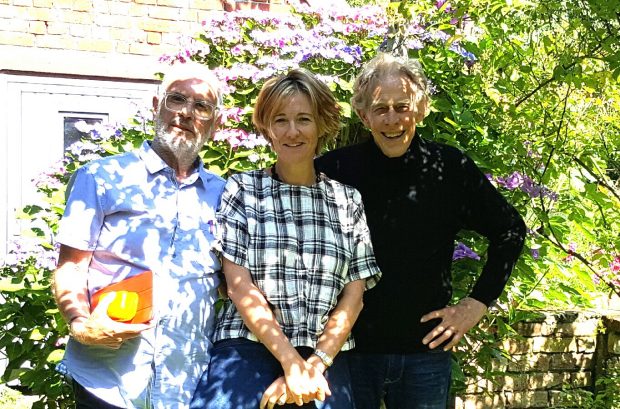
Philip Nitschke, Fiona Stewart & Boudewijn Chabot, 2016
Since the beginning of this century, he has had all known lethal substances in his home, he says in the front room of the stately house in Haarlem where he grew up and which has been in his family’s possession since 1922. “You name it, I have it,” he says.
In his shed is a tank of helium.
In his cupboards are jars of pentobarbital.
With a malaria drug.
And at least twenty boxes of Depronal, a banned, lethal painkiller – bought long ago during a vacation in Spain.
“I got them over the counter just like that. You actually need much less to die,” he says, “but the lady at the village pharmacy wanted to get rid of them.”
These are pills, drinks, and gases for a relatively quick, and sometimes even painless, death. Yet he will soon choose—if he can choose—a slow method. A path where he will steadily lose weight and dehydrate.
And he doesn’t know how long it will take.
“This is my firm intention,” he says. “I don’t know if I’ll succeed, but I think it’s by far the best way to say goodbye to my wife and daughter and a few friends. Precisely because it takes several days.”
In what kind of situation would you choose that?
“Everything I have prepared stems from a fear of dementia. That is not on the horizon. But for a month or two now, I have had a heart condition that, according to the cardiac surgeons, cannot be operated on. I have had four bypasses and calcified heart valves. In a while, it’s unclear exactly how long, my heart will no longer be able to pump blood properly.
When I become short of breath at rest, I will have reached my limit. My loved ones, together with my family doctor, can organize care at home in a day or two. Once that is arranged, I will stop eating and drinking.”
What would you be afraid of if you did that?
He hesitates for a moment. “I don’t think I’m afraid of anything.”
“Do you know what I’m afraid of?” he immediately adds. “I have a heart that fibrillates. This week, I was in the shower and I thought: what if I have an attack here?
I’ll collapse, try to crawl outside, but maybe my wife won’t find me until half an hour later, unconscious. Too late to say goodbye.
I would find that a disaster. I hardly dare cycle on the street anymore, for fear of being hit by a fat bike and ending up in a hospital bed in a coma, unable to say anything.
“But if I can organize it here at home, with loved ones around me, in that room, with a nice high-low bed, then I’m not afraid of anything.”
Not even thirst? Hunger?
“No. This method is unpleasant. It’s unpleasant not to drink. But it’s a very good test to see if you really want to die. You have to be steadfast.
Look, if you take a drug, you can’t vomit it up again very quickly. When you stop eating and drinking, you can stop at any time. I think that’s the big advantage.”
Chabot’s openness about his own death is related to new research from Erasmus MC, which was published on Friday.
It is a repeat study of his doctoral research. At the beginning of this century, he investigated how often people chose two methods to die on their own terms—stopping eating and drinking and taking (sleeping) pills—and what their experiences were.
His research made it clear that people died in this way “surprisingly” often, something that was “collectively ignored” by society, he wrote.
The results of the new study, focusing on the period 2019-2023, are once again striking. Every year, thousands of people in the Netherlands end their lives by deliberately stopping eating and drinking.
This amounts to approximately 5,800 people per year, or 3.5 percent of all deaths. That is significantly more than the 2,800 cases reported by Chabot at the time.
In addition, around 2,000 people end their lives each year by taking (sleeping) pills – at 1.2 percent, this proportion remained virtually unchanged. More than a quarter of them used Middel X, the legal but difficult-to-obtain substance that was presented in 2017 as a suicide powder.
This study also shows that many initially preferred to leave this choice to their doctor. Two-thirds of the people who stopped eating and drinking had previously requested euthanasia. Of the people who took sleeping pills or Middel X, half had done so. Their requests were rejected.
Boudewijn Chabot, born in Makassar, in what was then the Dutch East Indies, is a psychiatrist who has never shied away from controversy. In 2010, he explicitly explained in his book Uitweg (Way Out) how people could die themselves.
Two years ago, at the age of 83, he also posted a video on his website with instructions on how to end one’s life with a nitrogen mask. The video, which he offers for €10, is sold about fifteen to twenty times a month, he says.
Quote from Boudewijn Cabot.
“When you die, you have to surrender yourself. You have to allow passivity and powerlessness; that’s what stopping eating and drinking requires.”
But above all, he is known for the “Chabot ruling”: in 1991, long before the euthanasia law existed, he provided lethal drugs to a 50-year-old woman who was suffering from severe mental illness.
He then voluntarily reported himself to the authorities. The Supreme Court ultimately ruled that he was ‘guilty’, but he received no punishment. His actions sparked a public debate about the limits of euthanasia.
Later, Chabot stated on several occasions that he would never again help a psychiatric patient to die. He developed a strong preference for ‘the autonomous route’, i.e. that a person takes responsibility for their own death and involves the doctor as little as possible.
‘At the time, I didn’t even know that it was possible to die on your own terms,’ he says. ‘Once I discovered that, I changed my mind. I thought: if you can organize a good death yourself, why ask the doctor?’
Do you feel responsible for the people who die with the help of your book or your nitrogen method?
“Of course. In a way, I feel guilty. I show people viable paths to death, something that has taken me years of research. But I think I can explain those choices well.
It has become increasingly difficult to obtain the right pills and powders; the government has made it virtually impossible.
I believe that adults should not be locked into life because there is no humane, safe, quick way to die in the presence of loved ones. That is why I launched the nitrogen method.”
You refer to stopping eating and drinking as death on one’s own terms. However, during that process, people become increasingly dependent on loved ones and doctors for care. Doesn’t that mean they lose control?
“That’s true. But dying means surrendering yourself. You have to allow passivity and powerlessness, which is what stopping eating and drinking requires.
Death is such a great mystery. Already at birth, with a child’s first cry, something happens to us that develops and only disappears with our last breath.
As humans, we must take responsibility for that transition ourselves. Let’s not outsource that to doctors.
Do you think stopping eating and drinking is a dignified death?
‘If you ask people: how do you want to die? They say: with dignity. But what does that mean? It’s a term that allows people to stop thinking about it.
An advertising concept. I prefer to talk about a good death.
So without pain or distress, not lonely and not violent. And that is possible, if you take the right precautions.’
How does such a dying process work?
‘In the beginning, you are very lucid. You can get out of bed and talk to people very well. It’s not hoops, floops, dead in one go, as with euthanasia. It’s a long farewell. Loved ones can slowly get used to the idea.
Wonderful.
‘After a while, your mouth gets dry and you become increasingly sleepy. Then you can no longer get out of bed or talk.
But your loved ones can take care of you, distract you, make you comfortable. I told my wife: read me some beautiful books or play my favorite music.
And if I suffer from delirium (severe confusion, ed.), my doctor has promised to come immediately, even at night.
He is a Buddhist who, on principle, does not perform euthanasia—which I think is a great idea—because he believes that it will affect a person in their next life. In the event of delirium, he will sedate me palliatively, put me to sleep.
Are you afraid of that?
I have experienced delirium twice. The last time was in 2004, after open-heart surgery. They immediately sedated me. I spent thirteen days in intensive care. Restrained. In my delirium, I wanted to escape – not from death, but from the hospital.
My plan was to pull the nurses’ hair and tear myself free. In reality, I could barely lift an arm.
‘It happened before that.
As a second-year medical student in Amsterdam, I ended up in the Diaconessenziekenhuis hospital with a perforated intestine and developed fever delirium.
In my confusion, I pulled out the IV. But then I got it into my head that the tip of the needle had broken off in my vein and remained there. I thought: that tip will soon slide into my heart and I will die a slow, painful death. A complete delusion, but I believed it.
With my bare bottom exposed, I ran down the hallway in my hospital gown and locked myself in the nurses’ station.
There I searched for poison. I did not want to die slowly—I preferred to die quickly. The nurses kept banging on the door. I climbed out the window and ended up on Overtoom in the dark, with the nurses chasing me. I wanted to jump into the canal. Eventually, someone stopped me and I was sprayed down.”
Are you surprised that so many people are stopping eating and drinking?
‘I was surprised at the time. And so was the entire medical world.
Initially, doctors said: that can’t be possible, we should have known that, right? But my research meant they couldn’t ignore it. The fact that the number has now increased is also because the KNMG medical association has decided to adopt the method.’
Death by refusing food and drink is registered as a ‘natural death’ and not as suicide. Don’t you find that strange?
‘Yes. I don’t know why that is, because someone consciously chooses to die.’ He pauses for a moment.
‘Now that I think about it, I do see stopping drinking as a natural process. People die by not doing something – similar to refusing antibiotics. If you then get pneumonia, you also die a natural death.’
In 2014, the KNMG medical association published its first “guidelines” for doctors to assist patients over the age of 60 in this regard. You contributed to this. Later, the age limit was dropped. Do you think this method is suitable for younger people?
‘I did not agree with all the wording in the revised guide. Anyone can stop eating and drinking; someone in their thirties can also persevere.
But a healthy person in their thirties will have a very hard time with thirst, because everything in their body, in their cells, will resist it.’
In 2015, Petra de Jong, former director of the Dutch Association for Voluntary Euthanasia (NVVE), called this method for healthy people “barbaric” and “medieval.”
She said that people sometimes lay screaming for water, that they were in pain and became confused. She called this ‘figure-it-out-yourself euthanasia’.
“But the NVVE has since changed its mind. A few years ago, they made a U-turn on this. They publish stories about it and have even asked me to update their consultants on the subject.”
The experiences of confidants varied. One described it as a gentle death, another as inhumane. Many people are afraid of suffering. Is that justified?
‘With good care, preventing the mouth from drying out, and pain relief, it can be made truly bearable. But you can’t talk people out of their minds. I once discussed this with a sociologist friend of mine.
His wife, who had survived a concentration camp, wanted to die. I talked to him about whether stopping food and drink would be an option.
Later, he told me how she had reacted. She said: ‘The Nazis tried to starve me to death. I’m not going to kill myself that way, am I? What is Chabot thinking?’
It is striking that nine of the eleven confidants said that the death had gone ‘according to plan’. At the time, you warned about the effects of this powder. Do you now have a more lenient view of Middel X?
“Yes. Because sometimes it does go well. So who am I to judge?”
You are a man who likes to be in control. Will it be difficult for you to let go?
“You’re right, yes. That will be very exciting for my wife and daughter. But I’ve changed quite a bit as I’ve gotten older.”
Have you become more lenient?
“They think so, yes.”
When you once had delirium, you instinctively chose a quick death. How does that fit in with your choice now?
‘Now I’m choosing a slow death.
The opposite, yes.
For me, that’s an interesting twist in my life, which isn’t entirely explainable. At the time, I calmed down because family members came to my bedside and talked to me.
I’ve agreed that my wife, my daughter, and others I trust will take turns sitting with me.
Because they know my rebellious nature. Rebellious to the end. ’