November 7, 2026
Landscapes of End: Film on the Taboo of Death
Sabina lives in a secluded farmhouse near Scarperia; she is alone and has felt the urge to end her life for years.
And now that her husband is no longer with her, this desire to die has grown stronger.
She discovers ‘Sarco’, the project devised by the doctor Philip Nitschke: a portable capsule that enables suicide without the assistance of a third party.
Perhaps an extreme stance, just as Sabina’s situation appears to be extreme.
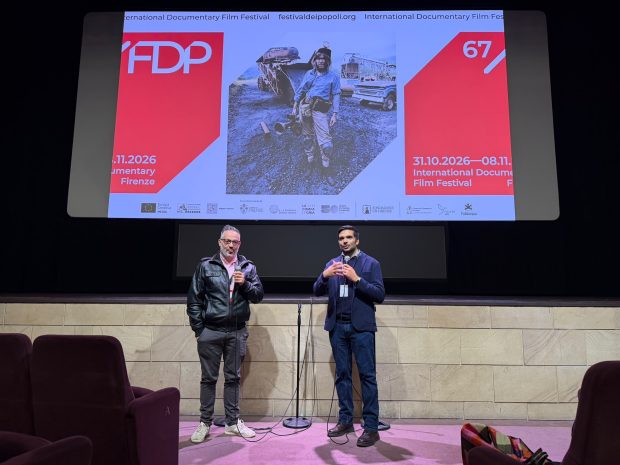
This is Landscape of Ending, the documentary that was screened yesterday at 5 pm at the La Compagnia cinema in Florence as part of the 67th Festival dei Popoli.
A film directed by Francesco Mattuzzi, it tells four stories, all interconnected: there is Sabina’s, in her ongoing dialogue with her friend Rosa.
Then there is the story of Philip Nitschke, who founded Sarco.
Next is the story of the scientist studying hairless heterocephalids, which could mark a turning point in research into extending life.
And finally, there is Sun City West, a community in Arizona where older people are enjoying a new lease of youth.
An emotional tale, “a hybrid documentary – as Mattuzzi describes it – that tackles a theme from cinéma vérité but with elements of fiction”, which, by showing life, speaks of death, transcending the meaning of death in its philosophical and social sense.
It is, in fact, a documentary “that has its roots far back; the initial idea came to me ten years ago when my daughter was born; witnessing the birth was like a revelation: birth is linked to death”.
Then came the meetings with psychologist Ines Testoni and Philip Nitschke.
nd it was precisely through the latter’s organisation, ‘Exit International’, that the meeting with Sabina came about: “They told me there was a woman with an incredible story who dreamt of using Sarco,” says the director.
“Telling her story wasn’t easy; her children feared we’d be adding fuel to the fire. But filming it was therapeutic for her; it gave her a reason to live that she hadn’t had before.”
A story told through colours that are darker here, almost nocturnal. It is an ongoing dialogue with Rosa, the friend who doesn’t share her views
“to use Sarco,” says the director. “Telling her story wasn’t easy; her children were afraid we’d be adding fuel to the fire.
But filming her was therapeutic for her; it gave her a reason to live that she hadn’t had before.”
A story told through colours that are darker here, almost nocturnal.
It is an ongoing dialogue with Rosa, the friend who disagrees with her, who explains why this is a selfish choice.
Sabina’s story is a significant one, “which I respect”, Mattuzzi continues.
Because this is a film without judgement: “That was the great challenge: it wasn’t meant to be an investigative film; I didn’t want one idea to take precedence over another.”
Sabina’s story is the latest film shot by Mattuzzi.
Alongside it, however, there are also the other three stories.
Death and life, then, are intertwined in an ending that remains a taboo, even though we devour horror films and crime news on a daily basis: “Take ‘Squid Game’,” observes Mattuzzi, “even primary school children watch it.
It’s absurd. But people don’t grasp the concept of death. This paradox exists, and in America it’s even more pronounced.”